



When the school bags are on the floor, dinner is half-made, and the washing still needs sorting, deep cleaning usually drops to the bottom of the list. That is exactly why a deep cleaning guide for busy families needs to be realistic. If the plan only works on a free weekend, it will not work for long.
The better approach is to treat deep cleaning like a system, not a marathon. Busy households do not need perfect homes. They need clean, healthy spaces that stay under control without taking over every spare hour. That means knowing what matters most, what can wait, and how to break bigger jobs into manageable blocks.
What deep cleaning actually means for a busy household
Deep cleaning is not the same as your regular weekly tidy-up. It goes beyond wiping benches, vacuuming visible floors, and doing the dishes. It means dealing with the build-up that slowly collects in corners, on skirting boards, behind appliances, inside bathrooms, and across the surfaces people touch every day but rarely clean properly.
For busy families, deep cleaning should focus on hygiene, function, and wear points. In practical terms, that means bathrooms, kitchens, floors, soft furnishings, high-touch surfaces, and hidden dust traps deserve attention before low-impact tasks like rearranging cupboards or alphabetising pantry jars.
That trade-off matters. If time is tight, a clean toilet, sanitised kitchen, and dust-reduced bedroom are more valuable than spending an hour polishing decor. The goal is a home that feels fresh, works better, and supports family life with less ongoing effort.
A deep cleaning guide for busy families starts with priorities
One of the biggest mistakes families make is trying to deep clean the entire house in a single day. It sounds efficient, but it usually ends with half-finished rooms, frustration, and a Monday that feels worse than Friday.
A better method is to divide the home into priority zones. Start with the spaces that affect daily life most. For most households, that means the kitchen and bathrooms first, followed by living areas and bedrooms. Hallways, laundry spaces, and less-used rooms can come after.
Within each zone, work from top to bottom and from dry tasks to wet tasks. Dust first, then wipe, then vacuum or mop. This avoids repeating work. It also gives the process a structure, which makes it easier to hand jobs across different family members or split tasks over several days.
If your schedule is packed, aim for 30 to 45 minute blocks rather than all-day cleaning sessions. Two focused blocks across a week often achieve more than one exhausting Saturday push.
Kitchen deep cleaning without losing the whole afternoon
The kitchen carries the heaviest load in most family homes. It gets constant use, quick spills, hidden grease, and daily foot traffic. That is why it should be high on any deep cleaning schedule.
Start with the areas that affect hygiene and food preparation. Benchtops, splashbacks, sinks, taps, cupboard handles, and appliance fronts should all be properly cleaned and sanitised. Then move to the less obvious build-up points, such as inside the microwave, the rangehood exterior, and the space around the bin area.
It helps to be selective here. Deep cleaning the entire pantry may not be necessary every month, but dealing with sticky shelves, expired food, and crumbs in drawers every few months makes a noticeable difference. The same goes for the fridge. A full empty-out can be time-consuming, so many families do better with shelf-by-shelf cleaning across the week instead of tackling the whole thing in one go.
Floors matter more than many people realise. Food residue and grease near kickboards and under chairs can build up quickly. A proper vacuum followed by a targeted mop, especially around cooking zones, improves both cleanliness and odour control.
Bathrooms need detail, not just speed
Bathrooms often look clean long before they are actually clean. A fast wipe of the vanity and a rinse of the shower can keep appearances up, but soap scum, grout build-up, mould-prone corners, and high-touch surfaces need more attention during a deep clean.
Focus first on the shower, toilet, vanity, mirrors, and floor edges. Clean and disinfect the areas people touch often, including flush buttons, taps, light switches, and door handles. Then tackle the places that collect moisture and grime over time, such as tile grout, shower screens, exhaust covers, and the seals around basins.
For families with young kids, this is one room where consistency matters more than intensity. If a full bathroom deep clean is too much to do weekly, split it up. One week, clean the shower thoroughly. The next, focus on grout, vents, and under-sink storage. Progress still counts if it is planned.
Bedrooms and living areas: reduce dust and reset the space
Living rooms and bedrooms may not feel as urgent as kitchens and bathrooms, but they have a direct impact on comfort, air quality, and how tidy the home feels overall. Dust, fabric fibres, pet hair, and clutter collect gradually, so these rooms benefit from targeted deep cleaning rather than constant fussing.
Start with soft surfaces. Vacuum rugs, under furniture edges, and upholstered seating properly, not just the visible centre area. If there are children in the home, check under couches and beds for forgotten rubbish, food wrappers, and toys that trap dust.
In bedrooms, focus on bedding, mattresses, skirting boards, blinds, and wardrobes. Rotating or vacuuming mattresses, washing pillow protectors, and dusting bedside surfaces can make the room feel noticeably fresher. It is also worth checking spots that are easy to overlook, such as ceiling fans, window tracks, and behind bedside tables.
Decluttering helps, but it should stay practical. Deep cleaning is easier when surfaces are clearer, yet many families lose momentum by turning every bedroom into a major sorting project. If time is limited, clear what is necessary to clean properly and leave the bigger organisation jobs for another day.
The most effective routine is the one your family can repeat
A strong deep cleaning routine is not built on motivation. It is built on repeatable effort. That means choosing a schedule that fits around school runs, work hours, sport, and the usual unpredictability of family life.
For some households, one room each week works well. Others do better with a monthly rotation, where one weekend covers bathrooms, another covers the kitchen, and the next handles living areas and bedrooms. There is no single right model. What matters is that the system is clear enough to keep going.
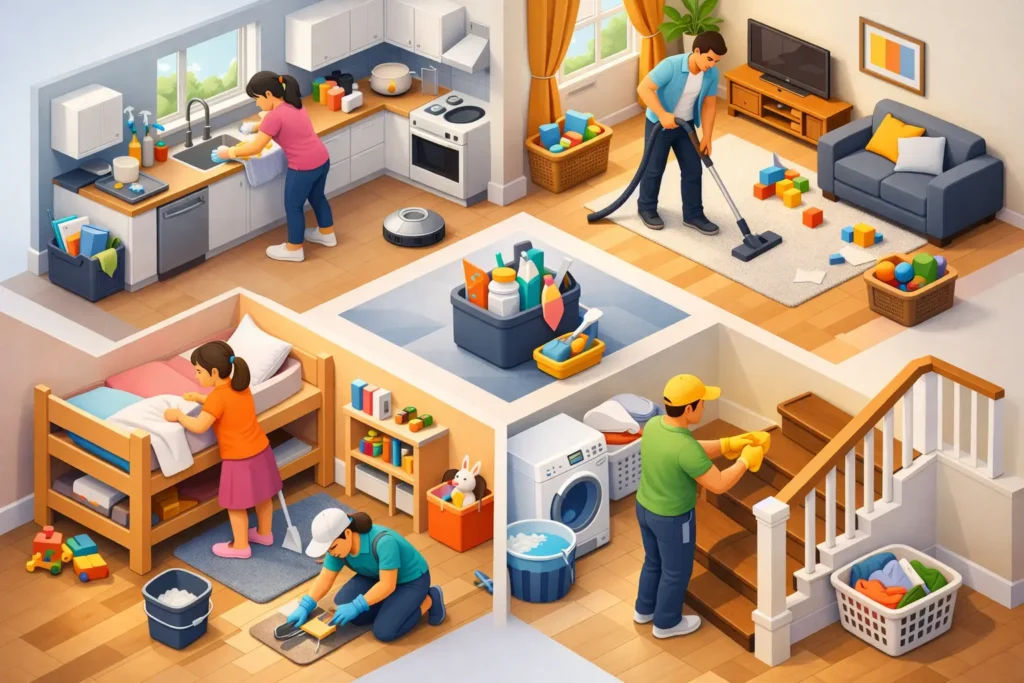
It also helps to assign jobs by skill and age, not by idealism. Younger kids can help with simple resets like putting toys away, wiping lower surfaces, or sorting laundry. Older children can vacuum, empty bins, and help with bathroom maintenance. Adults can handle products, tougher grime, and higher-risk tasks. Shared responsibility reduces the load and stops deep cleaning from becoming one person’s problem.
When to do it yourself and when to bring in help
There is a point where doing everything yourself stops being efficient. If work is flat out, weekends are already booked, or certain tasks keep getting pushed back for months, professional help can be the more practical option.
That does not mean outsourcing everything. Many families manage routine cleaning themselves and bring in support for heavier work such as full kitchen resets, bathroom deep cleans, steam cleaning, or end-of-lease style cleaning before major events or seasonal resets.
This is especially useful when the home has gone beyond a manageable weekly standard. Starting with a professional deep clean can create a cleaner baseline, making regular upkeep much easier afterwards. It is the same logic commercial sites use – get the standard right first, then maintain it consistently.
For families in busy parts of South-East Melbourne, where long commutes and packed schedules are common, that kind of support can save more than time. It reduces stress, improves consistency, and stops cleaning from becoming a recurring catch-up job.
Keep standards high without making cleaning the centre of family life
The most effective homes are not cleaned constantly. They are managed well. Shoes have a place, spills are handled early, bathrooms get light maintenance between deeper cleans, and clutter does not sit for weeks. Those small systems protect the bigger cleaning effort.
That is the real value of a practical deep cleaning guide for busy families. It gives you a way to stay ahead without expecting unrealistic energy or endless spare time. Cleanliness should support the household, not control it.
If your current routine feels patchy, start smaller than you think you need to. Pick one room, set one standard, and make it repeatable. A home does not need perfect timing to stay clean. It needs a plan that still works when life gets busy.