


The first month usually looks good. Floors are spotless, bins are emptied properly, bathrooms stay presentable, and communication feels easy. Then, slowly, standards drop. If you have been wondering why your commercial cleaner starts strong then gets worse over time, the answer is rarely effort alone. More often, it comes down to weak systems, poor supervision, rushed staffing, or a service model built to win contracts rather than sustain them.
For office managers, site supervisors, clinic operators and warehouse teams, this pattern is frustrating because it creates extra work. You are not paying for a strong start. You are paying for reliable performance every week, with minimal follow-up. When that consistency disappears, the real cost is not just cleaning quality. It is time, disruption, complaints, and the need to constantly check work that should already be under control.
Why your commercial cleaner starts strong then gets worse over time
A lot of cleaning companies are very good at onboarding. They send their best cleaner to the first few visits, allocate extra time, and keep communication tight while the account is new. On paper, that sounds sensible. In practice, it can create a false baseline if the service is not supported by a repeatable system.
Once the initial attention fades, the job often shifts to whoever is available. Visit times get compressed. Supervisors stop inspecting as often. Small misses begin to appear, then become routine. Smudged glass, corners left untouched, bathrooms cleaned inconsistently, rubbish removed but liners not replaced – these are not random mistakes. They are usually signs that the service was never built for long-term control.
That is the main issue. Strong starts are easy. Sustained standards are operational.
The real reasons cleaning standards decline
The cleaner changes, but the site knowledge disappears
Commercial cleaning works best when the person on site understands the building, the priorities, and the non-negotiables. A medical clinic has different risk areas from a warehouse. A retail site has different presentation pressures from an office. When cleaners are replaced without a proper handover, the site effectively resets.
This is where many providers struggle. They rely too heavily on individual cleaners rather than documented site plans. So when staffing changes happen, and they always do, quality drops because the knowledge was never captured properly.
A good operator expects staff movement and plans for it. That means clear scope documents, task schedules, site notes, and practical supervision. Without that structure, every staff replacement becomes a service risk.
Time gets cut after the contract is won
This is one of the most common reasons a service deteriorates. In the early stage, cleaners may be given enough time to do the job well. Later, schedules are tightened to improve margins or absorb staffing pressures elsewhere.
The result is predictable. The cleaner still attends, but less gets done. Visible surfaces may look acceptable at a glance, while detailed tasks start slipping. Skirting boards, touchpoints, edges, kitchen areas, stockroom floors and staff amenities begin to show the difference first.
From a client perspective, it can feel confusing because nobody announces the change. The service looks similar on paper, but the output is weaker. If standards have dropped while the checklist still looks the same, reduced labour time is often part of the problem.
Supervision fades once the relationship settles
Many cleaning issues are not caused by a bad cleaner. They are caused by poor oversight. Early in a contract, management attention is often high. There are more check-ins, faster responses, and tighter quality control. After a few months, that attention can disappear.
When inspections become irregular, small problems linger longer. When small problems linger, they become normal. Over time, this resets the standard downward.
Reliable commercial cleaning should not depend on the client being the quality manager. If you are the one noticing every missed task, following up every concern, and reminding the provider what was agreed, the system is failing long before the cleaner is.
Communication becomes reactive instead of structured
At the start, many providers are responsive because they are trying to establish trust. Later, communication often becomes patchy. Messages are answered more slowly. Issues are acknowledged but not fully resolved. You start hearing reasons instead of seeing outcomes.
This shift matters because cleaning quality and communication quality are closely linked. A service with clear reporting, regular check-ins and visible accountability is easier to manage and easier to trust. A service that only responds when something goes wrong usually has limited internal control.
For busy businesses, especially those managing multiple priorities, reactive communication adds management load. You should not need to chase basic updates or prove that a task was missed.
Why low-price contracts often decline faster
Price always matters, but there is a practical limit. If a quote is built too tightly, the provider has very little room to maintain quality over time. Cleaner wages, supervision, travel, equipment, training and consumable management all affect delivery. If the numbers do not support the scope, something eventually gives.
Usually, it is consistency.
This does not mean the highest quote is automatically better. It means realistic pricing tends to support stable staffing and better oversight. Very cheap contracts often begin with good intent, then run into the reality of under-resourcing. The cleaner rushes, management reduces support, and the client ends up paying in a different way – through complaints, rework and wasted time.
What to look for if your cleaner is slipping
If standards are getting worse, the question is not only whether tasks are being missed. It is whether the provider has a reliable operating model behind the service.
Look at how site expectations are documented. Check whether inspections actually happen and whether feedback leads to change. Ask who covers the site if the regular cleaner is away, and how handovers are managed. Find out whether reporting is built into the service or only used when there is a problem.
It is also worth paying attention to patterns. If issues keep appearing after weekends, staff leave, public holidays or busy periods, that usually points to staffing depth and operational planning. If quality is different depending on who attends, that suggests the business relies too much on individuals and not enough on process.
Why your commercial cleaner gets worse over time in larger or mixed-use sites
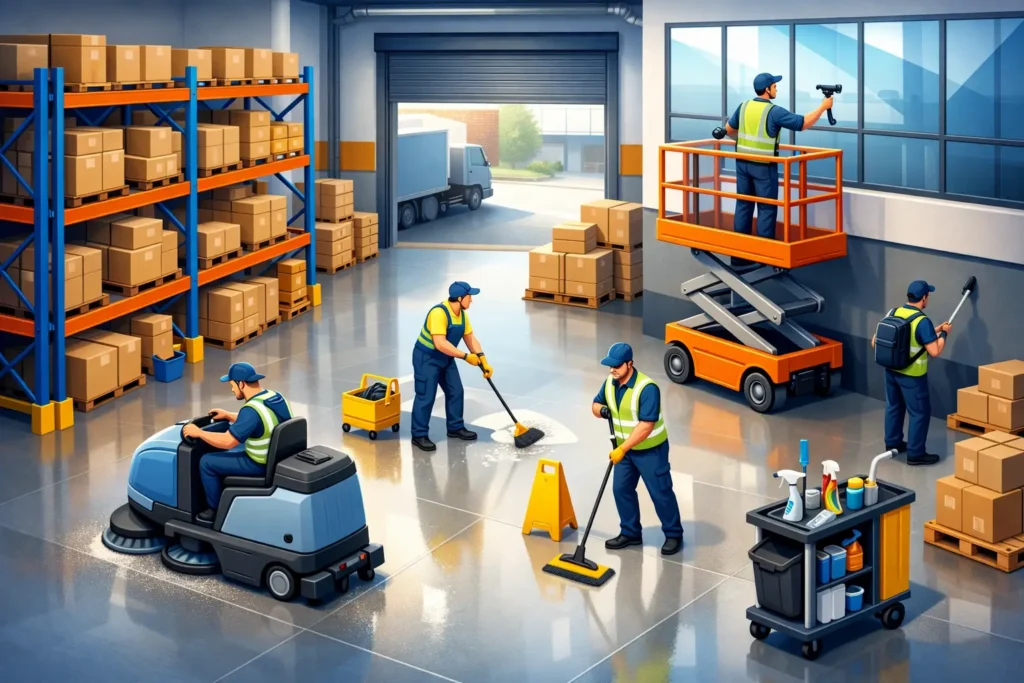
The bigger and more varied the site, the more obvious weak systems become. In a small office, a drop in quality may show up as untidy amenities or dusty desks. In a warehouse, factory or multi-zone facility, the impact is broader. High-traffic entries, lunchrooms, offices, bathrooms and operational areas all have different cleaning needs and different frequencies.
Without a structured plan, cleaners naturally focus on what is most visible or easiest to complete in the time available. That means less visible but still important areas get pushed back repeatedly. Over time, the site starts to feel inconsistent. Some zones look fine, while others clearly do not.
That inconsistency is a sign that the service is not being actively managed to the site requirements.
What consistent commercial cleaning actually looks like
Consistency comes from systems that keep working after the first month. That includes clear scopes, scheduled tasks, site-specific training, regular inspections, backup staffing, and direct communication when something changes. It also means problems are addressed early, before they become recurring complaints.
This is especially important in workplaces where presentation, hygiene and compliance matter every day. Medical centres, hospitality venues, offices receiving clients, and industrial facilities with shared staff areas all need more than occasional good performance. They need dependable standards without constant supervision.
That is why performance-based cleaning matters. A provider should be able to show how quality is monitored, how issues are recorded, and how service continuity is maintained when staffing changes. At NovaOne Property Services, that focus on structure and accountability is what helps reduce the common cycle of strong starts followed by gradual decline.
When it is worth changing providers
Not every dip in performance means the relationship is over. Sometimes the issue is fixable if the provider responds quickly, resets expectations, and improves oversight. But if the same concerns keep returning, or if quality only improves briefly after complaints, that usually means the underlying system is weak.
At that point, the problem is no longer a missed bin or an overlooked bathroom detail. It is that your cleaning service is taking more management effort than it should. For most businesses, that defeats the purpose of outsourcing in the first place.
A dependable commercial cleaner should reduce operational friction, not add to it. If your current service started strong but no longer feels reliable, that is not something to normalise. It is usually a sign that the business behind the cleaner is not built for consistency.
The right cleaning partner is not the one that impresses you in week one. It is the one that still performs properly in month six, after staff changes, busy periods and day-to-day pressures have tested the system.