

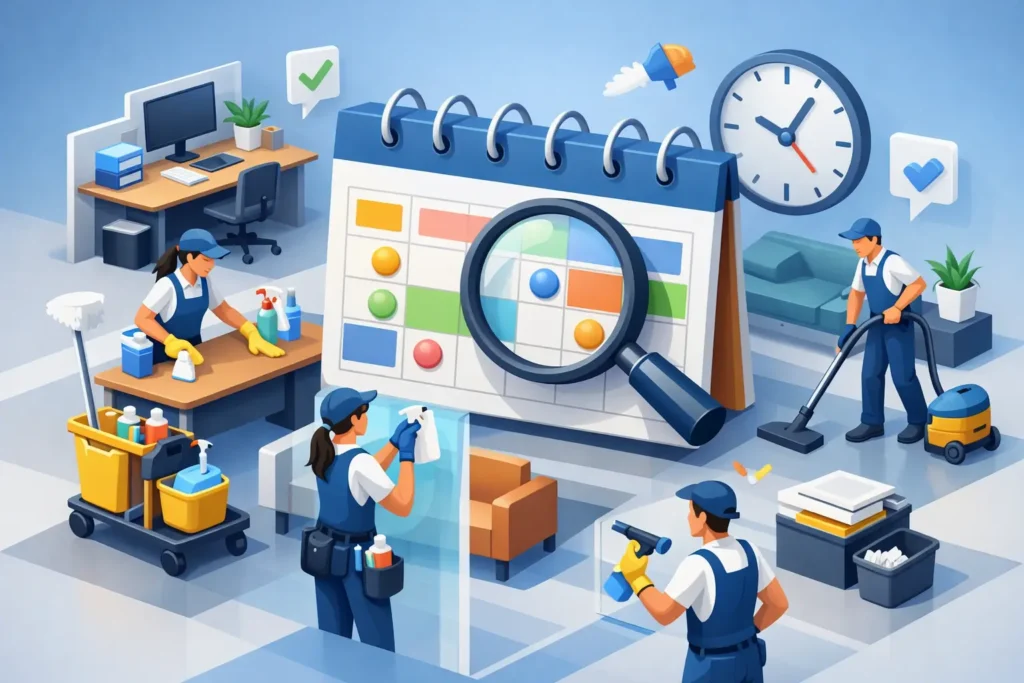
If your current cleaner calls in sick, misses key tasks, or needs constant follow-up, the question of commercial cleaning vs in house stops being theoretical very quickly. It becomes an operations decision. For offices, warehouses, medical sites, retail stores and hospitality venues, the right cleaning model affects presentation, staff time, compliance, and cost control.
There is no single answer for every business. Some sites are better suited to an internal cleaning team. Others get better value, stronger consistency and less management pressure from an outsourced provider. The right option depends on how your business runs, how critical cleaning is to daily operations, and how much oversight you want to carry internally.
Commercial cleaning vs in house: what are you really comparing?
At face value, the comparison looks simple. In-house cleaning means you recruit and manage your own staff. Commercial cleaning means you appoint an external contractor to deliver the service.
In practice, the difference is much bigger than who holds the mop. You are comparing labour management, scheduling, quality control, absenteeism, equipment supply, chemical handling, training, supervision, reporting and continuity of service. That is why the cheapest hourly rate on paper often tells only part of the story.
For many business owners and site managers, the real issue is not just cleaning cost. It is whether the service can run properly without becoming another daily problem to manage.
Tired of unreliable cleaners?
Where in-house cleaning makes sense
An in-house model can work well when cleaning is closely tied to your internal operations. If you run a site with unusual access requirements, changing production schedules, or cleaning tasks that need immediate response throughout the day, having your own staff on hand can offer more direct control.
It can also suit businesses with a strong internal management structure. If you already have supervisors, HR processes, procurement systems and spare capacity to train and monitor cleaners, adding cleaning staff may feel manageable. Some larger organisations prefer this arrangement because they want full control over hiring, site knowledge and day-to-day priorities.
There is also a familiarity benefit. Internal staff often know the team, understand the site layout, and become part of the workplace routine. In some environments, that continuity matters.
That said, in-house only works well when it is treated as an operational function, not an afterthought. Cleaning standards usually slip when businesses hire someone casually, give them basic supplies, and assume the work will take care of itself.
The hidden demands of an in-house team
The main advantage of in-house cleaning is control. The main downside is that you have to use that control properly.
Recruitment is the first pressure point. Finding reliable cleaners is not always easy, especially for early mornings, evenings, split shifts or physically demanding sites. Once hired, they need training, inductions, safe work procedures and ongoing supervision. If performance drops, the issue sits with your team to correct.
Then there is coverage. Annual leave, sick leave, lateness and staff turnover do not disappear because the role is internal. They become your problem to backfill. If no replacement is available, the work is delayed or skipped. For businesses where presentation and hygiene standards matter every day, that gap can show up quickly.
Supply management is another cost that often gets underestimated. Consumables, chemicals, equipment maintenance, storage, test and tag requirements, and safety documentation all need someone to manage them. On paper, in-house may look cheaper. In reality, many businesses end up paying through management time, inconsistent output and service interruptions.
Why many businesses move to commercial cleaning
Outsourcing usually becomes attractive when cleaning needs to happen consistently without pulling managers into routine follow-up. A professional commercial cleaning provider should bring trained staff, structured schedules, quality checks and replacement coverage as part of the service.
That matters most in environments where cleaning is essential but not core business. An office manager should not have to chase missed bins. A warehouse supervisor should not be sourcing backup cleaners at 5 am. A medical administrator should not be second-guessing whether hygiene tasks were completed properly.
A good contractor reduces that internal load. Instead of managing individuals, you manage outcomes. That is a major difference.
For growing businesses, outsourcing also scales more easily. If you add floor space, extend operating hours or open another site, the service can usually be adjusted without the same recruitment and onboarding burden that comes with building an internal team.
Commercial cleaning vs in house on cost
Cost is usually the first thing decision-makers compare, but it needs to be compared properly.
In-house costs include wages, superannuation, leave, payroll admin, recruitment, training, consumables, equipment, storage, uniforms, insurance considerations and supervision time. Those expenses are spread across different parts of the business, which is why internal cleaning can appear less expensive than it really is.
Commercial cleaning is more straightforward. You are typically paying an agreed service fee for defined outcomes. That can make budgeting easier, especially when the scope is clear and the provider is properly structured.
The lowest quote is not always the lowest cost. If a contractor is cheap but inconsistent, your staff still end up checking work, following up problems and dealing with complaints. Cheap cleaning often becomes expensive once poor quality, missed services and disruption are factored in.
The better comparison is total operational cost, not headline hourly rate.
Reliability matters more than most businesses expect
Cleaning is one of those services that only gets attention when it fails. Overflowing rubbish, dirty amenities, dusty surfaces or poorly maintained floors are visible immediately. Staff notice. Customers notice. Auditors notice.
This is where the difference between a casual arrangement and a structured commercial service becomes clear. Reliable providers build systems around service continuity. That includes documented scopes, trained backup staff, regular inspections and clear communication when issues arise.
Without those systems, businesses tend to experience the same pattern: a good start, then missed details, then inconsistent attendance, then frustration. That is often the point where businesses revisit the commercial cleaning vs in house question and realise they are not just choosing labour. They are choosing how much risk they want to carry.
Control vs accountability
Some businesses hesitate to outsource because they worry about losing control. That concern is fair, but control and accountability are not the same thing.
With in-house cleaning, you have direct authority over staff, but you also carry full responsibility for output. With commercial cleaning, you are handing over day-to-day delivery, but a good provider should give you stronger accountability through reporting, site inspections and clear service standards.
That can actually increase confidence, not reduce it. If the service is measured properly, problems are easier to identify and correct. The strongest outsourced arrangements are not hands-off in a careless way. They are hands-off because the systems are doing the work.
For businesses in South-East Melbourne managing busy commercial or industrial sites, this is often the deciding factor. The goal is not to personally control every cleaning task. The goal is to know it is being done properly without constant intervention.
Which model suits different site types?
Offices often benefit from outsourced cleaning because the tasks are routine, after-hours access is common, and consistency matters more than having a cleaner on payroll. Warehouses and factories can go either way depending on the complexity of the site, but many operators prefer commercial cleaning for larger floor areas, amenities, and scheduled deep cleaning support.
Medical centres, childcare environments and food-related venues need stricter procedures and dependable standards. In these settings, the capability of the provider matters more than the label of in-house or outsourced. If your internal team cannot maintain training, documentation and consistent execution, outsourcing to a specialist commercial cleaner is usually the safer decision.
Retail sites and hospitality venues often need flexibility around trading hours and presentation standards. That tends to favour a contractor with enough staff and structure to respond quickly when requirements change.
The better question to ask
Rather than asking which model is better in general, ask which model creates fewer problems for your business over the next 12 months.
If you have the internal resources to recruit well, train properly, supervise consistently and cover absences, in-house may work. If you want predictable service, lower management effort and clearer accountability, commercial cleaning is often the stronger option.
For many businesses, the tipping point is simple. Once cleaning starts taking management time away from operations, sales, staff or customer service, it is no longer just a cleaning issue. It is an efficiency issue.
That is why many businesses choose a structured provider such as NovaOne Property Services – not just to get the site cleaned, but to remove uncertainty from the process.
The right cleaning model should make your business easier to run. If it is doing the opposite, the answer is probably already in front of you.