

If your site only gets attention when something looks obviously dirty, standards are already slipping. A practical workplace cleaning checklist for Cranbourne businesses helps prevent that drift. It gives managers, business owners and site supervisors a clear benchmark for presentation, hygiene and safety – without relying on memory, rushed inspections or constant follow-up.
For most commercial sites, the issue is not knowing that cleaning matters. The issue is consistency. Offices get busy, warehouses focus on throughput, retail teams prioritise customers, and shared areas are everyone’s responsibility until they become no one’s responsibility. A checklist fixes that by turning cleaning from a vague expectation into a measurable routine.
Contact NovaOne Property Services today for a customised commercial cleaning solution tailored to your business needs.
Request Your Free Quote Today
📞 Phone: 1300 788 845📧 Email: support@novaoneproperty.com.au 🌐 Website: www.novaoneproperty.com.au
✅ Fast response times ✅ Flexible commercial cleaning solutions
Why a workplace cleaning checklist matters
A clean workplace affects more than appearance. It shapes staff confidence, visitor impressions, hygiene outcomes and day-to-day efficiency. In some settings, such as medical clinics, food venues or childcare environments, cleaning standards also sit close to compliance obligations. In offices and industrial spaces, poor cleaning still creates costs through complaints, distractions, avoidable hazards and extra management time.
The real benefit of a checklist is control. You can see what needs to be done, how often it should be done, and whether the standard is being met. That matters even more if you have had unreliable cleaners in the past or if multiple staff members use the same areas across different shifts.
For Cranbourne businesses, this can be especially relevant in mixed-use commercial areas where offices, showrooms, workshops and warehouses often sit side by side. A one-size-fits-all routine rarely works. Your checklist needs to reflect how your site actually operates.
Building the right workplace cleaning checklist for Cranbourne businesses
A good checklist should match the type of premises, the number of staff, customer traffic, and the level of hygiene risk. A quiet admin office needs a different schedule from a busy medical centre or a warehouse with regular dust, pallet movement and staff amenities under heavy use.
That is why the best checklists are structured by zone and frequency. Instead of using one long generic list, break cleaning tasks into daily, weekly and periodic work across specific areas. This makes it easier to inspect, easier to manage, and much harder for recurring problems to be missed.
Entry, reception and customer-facing areas
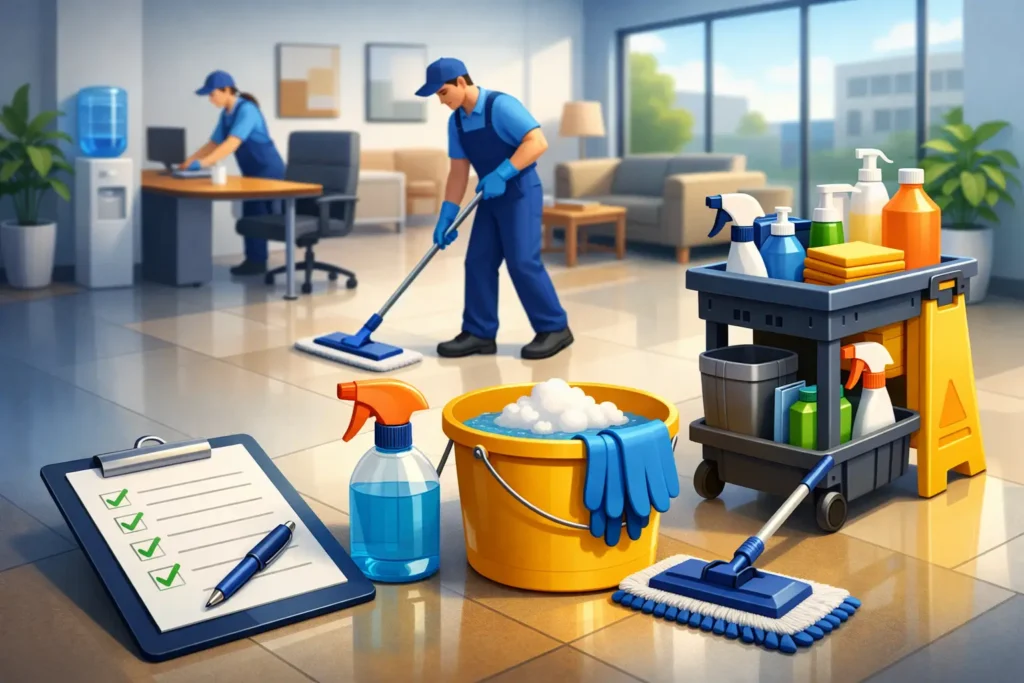
These are the first spaces people see, and they tend to shape their impression of the whole business. Floors should be vacuumed or mopped as needed, glass entry doors spot-cleaned, fingerprints removed from touchpoints, and reception desks wiped and sanitised. Rubbish bins should be emptied before they overflow, not after.
In customer-facing environments, detail matters. Smudged glass, dusty skirting, stained mats or overflowing bins can make an otherwise professional business look poorly managed. If your site receives regular visitors, this area usually needs daily attention, sometimes more than once a day.
Workstations, offices and meeting rooms
Office areas often look clean at a glance while still carrying a build-up of dust, marks and germs. Desks, shared tables, chair arms, light switches and door handles should be wiped regularly, especially in shared-use environments. Floors need vacuuming, and high-touch surfaces should be sanitised on a scheduled basis.
Meeting rooms deserve their own line items in the checklist. They are often used by different people throughout the day and can quickly collect cups, crumbs, fingerprints and stale air. A quick reset after use is ideal, but there should also be a scheduled clean that covers tables, chairs, screens, remotes and flooring.
Kitchens and staff break areas
This is one of the fastest places for standards to fall. Sinks, benches, taps, cupboard handles, appliance exteriors and eating surfaces need regular cleaning. Fridge handles, microwaves and kettles are touched constantly and often missed.
A workable checklist should separate what staff are expected to do from what is handled through scheduled cleaning. If that line is unclear, kitchens become a source of friction. It is reasonable to expect staff to clear their own food and spills, but routine sanitising and detailed cleaning should be assigned properly and checked.
Bathrooms and washrooms
If you want one area where there is no room for inconsistency, this is it. Toilets, urinals, basins, mirrors, dispensers, partitions and floors all need frequent attention. Restocking toilet paper, soap and hand towels should be part of every service, not an afterthought.
Bathrooms are also where poor cleaning is noticed fastest. Bad odours, empty dispensers or visibly dirty surfaces create immediate complaints. In high-traffic workplaces, daily cleaning may not be enough. Some sites need multiple checks across the day, particularly where customers or large teams use the facilities.
Warehouses, factories and back-of-house spaces
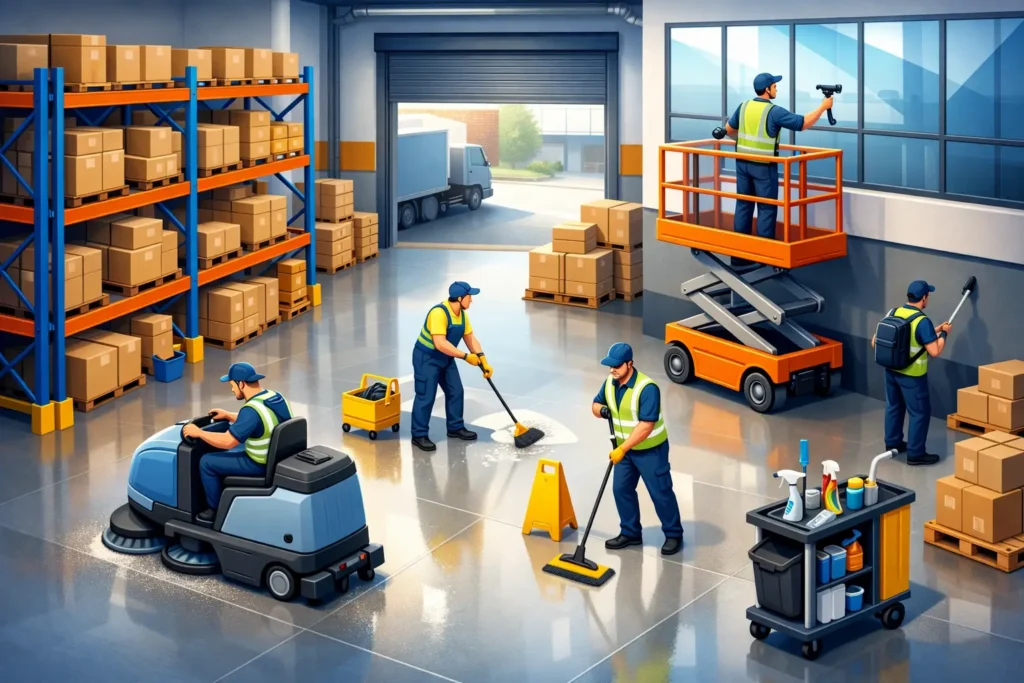
Industrial and operational sites need a checklist that reflects real conditions. Dust, packaging waste, tracked-in dirt, grease and heavy staff movement all change the cleaning load. Lunchrooms, offices and amenities still matter, but so do walkways, entry points, touch surfaces and debris-prone areas.
The right approach depends on the work being done. A logistics site may need strong floor maintenance and bin management. A factory may need closer attention to residue and safety around work zones. Cleaning should support operations, not interfere with them, so scheduling around shifts and production hours is often part of the checklist design.
What to include by frequency
Daily tasks usually cover visible presentation and hygiene essentials – bins, vacuuming, mopping, bathroom cleaning, kitchen cleaning, sanitising touchpoints and tidying shared areas. Weekly tasks often go deeper, such as detailed dusting, internal glass, skirting boards, hard-to-reach surfaces and more thorough bathroom attention.
Then there are periodic tasks that should not disappear just because they are less obvious. These may include carpet steam cleaning, deep kitchen cleaning, wall spot cleaning, high dusting, floor scrubbing, window cleaning and detailed sanitisation in higher-risk environments. If these jobs are not scheduled clearly, they are usually the first to get skipped.
A useful checklist also names the expected result. For example, instead of writing clean bathroom, specify sanitise toilet, wipe basin and taps, clean mirror, mop floor and restock consumables. Clarity reduces missed tasks and removes ambiguity when inspecting quality.
Common mistakes businesses make
One of the biggest mistakes is using a generic checklist copied from another site. What works for a small office rarely works for a showroom, clinic or warehouse. The second mistake is overloading the list with unrealistic expectations that do not match the available time or service frequency.
Another common issue is assuming that once a checklist exists, the work is managed. It is not. A checklist only improves standards if someone reviews it, inspects outcomes and acts on issues early. Without accountability, even a well-written schedule becomes paperwork.
There is also a trade-off between frequency and depth. Some businesses want every area cleaned in detail every visit, but that may not be the most efficient use of time or budget. In many cases, a better result comes from consistent daily essentials backed by scheduled deeper cleaning at the right intervals.
How to make the checklist work in real operations
Start by identifying the spaces that create the most complaints, risk or visible impact. That usually means bathrooms, kitchens, entry areas and any customer-facing zone. Then map out the tasks that must happen daily, the tasks that can happen weekly, and the tasks that need a monthly or periodic schedule.
Next, assign responsibility clearly. If some tasks are internal and others sit with your cleaning provider, document that. Ambiguity causes missed work and finger-pointing. Good cleaning management relies on clear scope, scheduled service and visible quality checks.
It also helps to inspect based on outcomes rather than effort. Staff and visitors do not judge a site by how hard someone worked. They judge it by whether the bathrooms are stocked, the floors are clean, the bins are emptied and the space feels cared for. That is why structured service delivery, regular inspections and photo-based reporting can be valuable for businesses that want less hands-on oversight.
For multi-site operators or growing businesses, consistency becomes even more important. A checklist standardises expectations across locations so one site does not quietly fall behind another. This is where working with a commercial cleaning provider that uses scheduled plans and quality control systems can reduce management time substantially.
When to review your cleaning checklist
Your checklist should change when your site changes. New staff, longer trading hours, seasonal traffic, renovations, compliance requirements or complaints are all signs that the current schedule may no longer be enough. If your team is constantly raising the same issues, the checklist either has gaps or the service is not being delivered consistently.
For businesses across South-East Melbourne, this review process is often where service quality improves the most. A cleaning plan should not stay static if the business has outgrown it. Operators who treat cleaning as part of site performance, rather than an afterthought, usually see fewer complaints and better day-to-day presentation.
NovaOne Property Services works with businesses that want that level of structure – clear schedules, accountability and reliable standards without the usual chasing and rework. Whether you manage an office, warehouse, retail site or medical facility, the right checklist should make cleaning easier to monitor and harder to get wrong.
A clean workplace should not depend on luck, memory or whoever notices the problem first. When the checklist is built properly and reviewed regularly, it becomes one of the simplest ways to protect presentation, hygiene and operational control.